

Networking
Deploy advanced LTE, 5G networks with advanced connectivity products.
Gen-AI
AI-powered telecom and edge computing for automated solutions.
Security
Securely connecting devices and protecting data
Industry 4.0 & IoT
IoT sensors and AI-enabled edge gateways for industrial transformation.
Collaboration
Unify teams with mobile PTT and integrated telephony solutions.
NanoLink
Closing Every Indoor Dead zone
Interested?
Home | Communication | P25 Radio System
P25 Radio System
P25 is the trusted technology for the most secure and safe land-mobile radio (LMR) communications in the event of emergencies, public safety events or military communications. Mission-critical communications with P25 are considered the gold standard for multi-agency voice and data LMR communications.
P25 Radio System
L3Harris Public Safety & Professional Communications (PSPC) is the premier world-wide provider of P25 solutions. Nybsys is a proud partner of L3Harris, offering L3Harris Core, Base stations, Radio End-points and BeOn mobile clients.
The Nybsys unique offer is an integrated Private LTE and P25 system where radios and regular mobile devices can interoperate on Push-to-Talk (PTT) channels while advanced voice-video communications take place on participating mobile clients. Nybsys Sentra PTT and 4G/5G solutions working with L3Harris VIDA Core, MASTER V Base Stations and XL-radios revolutionizes Incident Response by lowering the barrier to entry for military-grade communications.
P25 is the trusted technology for the most secure and safe land-mobile radio (LMR) communications in the event of emergencies, public safety events or military communications. Mission-critical communications with P25 are considered the gold standard for multi-agency voice and data LMR communications.
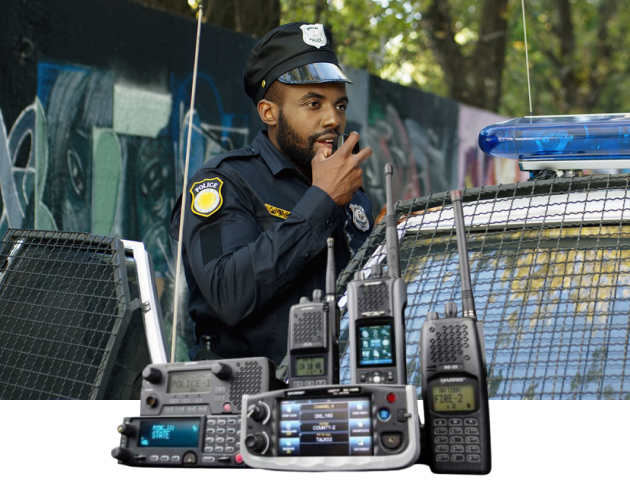
P25 Radio System Overview
Initiated and led by the public safety community, P25 was standardized by the Telecommunications Industry Association (TIA) for use by local, state and federal public safety organizations in North America. Due to its popularity, P25 can be found all over the world.
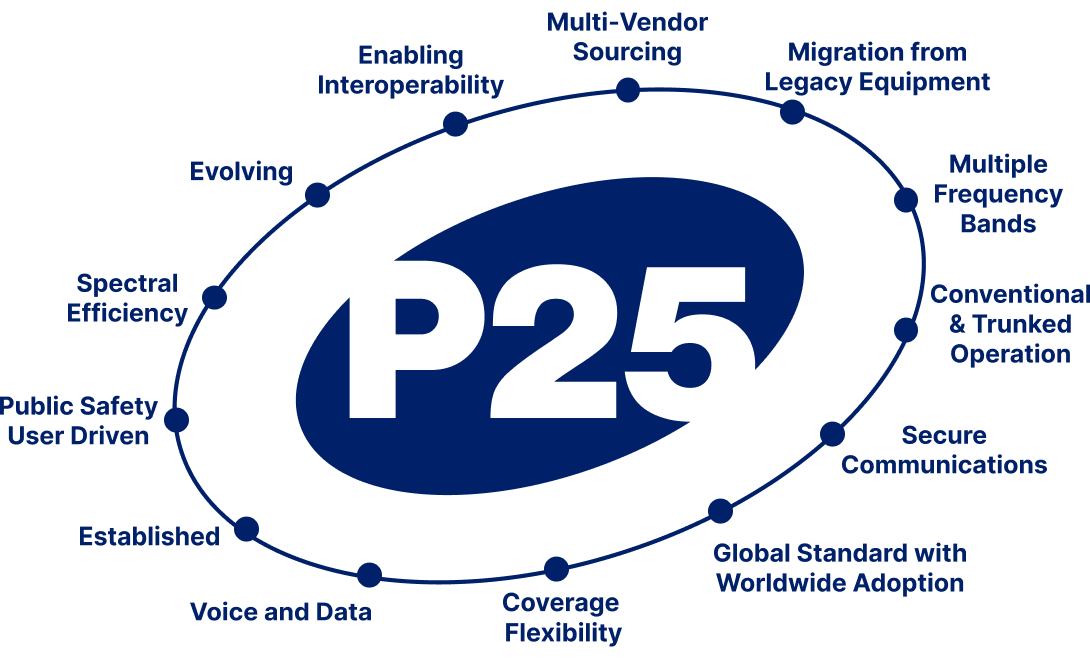
Radio users depend on P25 for their mission-critical communications due to its benefits in performance, efficiency, capabilities and quality.
Radio users depend on P25 for their mission-critical communications due to its benefits in performance, efficiency, capabilities and quality.
- P25 supports a variety of call types and features to each radio user. These call features include group and individual calls, emergency calls, encryption, unit IDs and supplemental services.
- To meet the needs of a wide range of users, both conventional and trunked operation is available in local and wide-area configurations.
- The P25 standard enables interoperability among products designed by multiple manufacturers, giving customers a variety of P25 portable radio solutions to choose from.
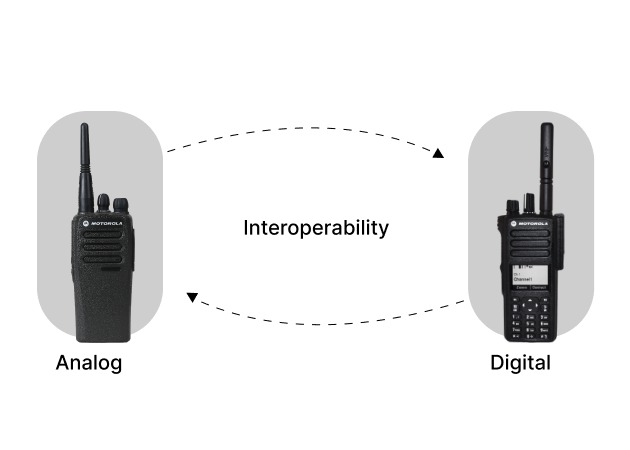
- In P25, Compliant radios may communicate in analog mode with legacy radios and in either digital or analog mode with other P25 radios.
P25 Benefits
- Interoperability and Continuous Connectivity
Interoperable emergency communication is integral to initial response, public health, community safety, national security and economic stability. The goal of P25 is to enable public safety responders to communicate with each other and achieve enhanced coordination, timely response, and efficient and effective use of communications equipment. - In mutual-aid situations, P25 open standards ensure connectivity within and between
organizations such as state and local public safety agencies, public works, and other utilities to restore services quickly and safely.
- Built-in Cybersecurity
Communication security is critical for public safety organizations and first responders. To protect against interception or eavesdropping from outside parties, P25 offers digital encryption for both voice and data. Unlike DMR or other lower-end LMR technologies, P25’s built-in advanced end-to-end encryption and security protocols keep the network, information, and communications safe from outside interceptionand evolving threats.
- Future Ready
The P25 standard provides unmatched flexibility for voice and data connectivity across current and emerging technologies including integrating LTE, GPS, Wifi,and Mission-Critical Push-to-Talk with your P25 LMR system, regardless of manufacturer.
P25 Radio System Architecture
The P25 overview diagram below shows how different P25-compliant networks can interoperate with each other. Users with P25 portable radios from different manufacturers can connect with the P25 towers and base-station infrastructure. The base stations connect with the application server, PABX and consoles over the IP network.
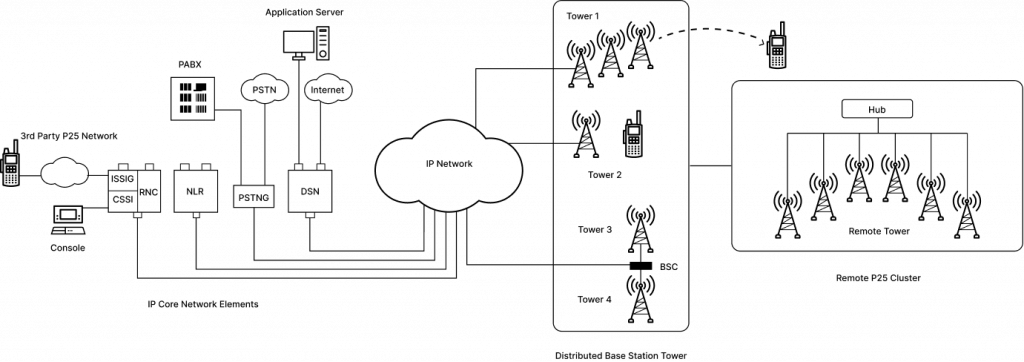
Diagram: P25 Network overview
Use case for integrated P25-LTE
In times of great emergency, such as the September 11th attacks, or in Hurricane Katrina, access to reliable, integrated communications and tactical information was found to be an absolutely critical need. Unfortunately, the ability to mount a coordinated inter-agency response to major threats was often hampered by the proliferation of divergent signaling standards and non-aligned spectrum planning. APCO Project 25 (commonly called “P25”) digital radio systems was introduced as a solution to the voice communications aspect of this problem. However while P25 systems might effectively support mission-critical voice and low-bandwidth data applications, they fail to provide the high-speed data performance necessary to support the multimedia applications on which today’s public safety agencies are increasingly relying. The 3GPP 4G Long Term Evolution (LTE) and subsequent 5G standards offer a solution to the need for wide-area broadband public safety networks.
Public safety is today undergoing a transition, from voice and low-bandwidth data applications carried on 700 MHz P25 narrowband networks to more advanced data-intensive applications supported by a 700 MHz LTE broadband network overlay. For public safety agencies, the result of combining the two networks is obvious: a unified broadband/narrowband communications infrastructure featuring the strengths of both technologies and on-going access to the continual advances being made with commercial cellular technologies and networks.
In operation, this combination would comprise an integrated network of mobile devices like 50-watt P25 mobiles with hot spots located throughout cities for LTE. As a ubiquitous system, P25 would remain the lifeline for public safety agencies. LTE would then offer them real-time access to an array of high-bandwidth applications that simply cannot be supported over narrowband wireless technologies like P25. These applications include, but are not limited to:
- High-speed Internet access to network systems and other systems/services available over the public Internet, for things like email and text messaging;
- VPN access for remotely accessing authorized sites and networks (e.g., the Incident Command System (ICS), and databases/report management systems);
- Status/information Short Message Service (SMS) and Multimedia Messaging Service (MMS) messaging;
- IP-based voice communications (including interoperability with legacy and new LMR infrastructure through the use of appropriate gateways) with things like push-to-talk services, biometrics, and telemedicine;
- Automatic vehicle location;
- Digital imaging;
- Streaming video (e.g., remote monitoring, surveillance at an incident, and high-resolution two-way video conferencing); and
- Full-duplex calling to any telephone device on the Public Switched Telephone Network (PSTN) with functionality comparable to that delivered with today’s cell phones.
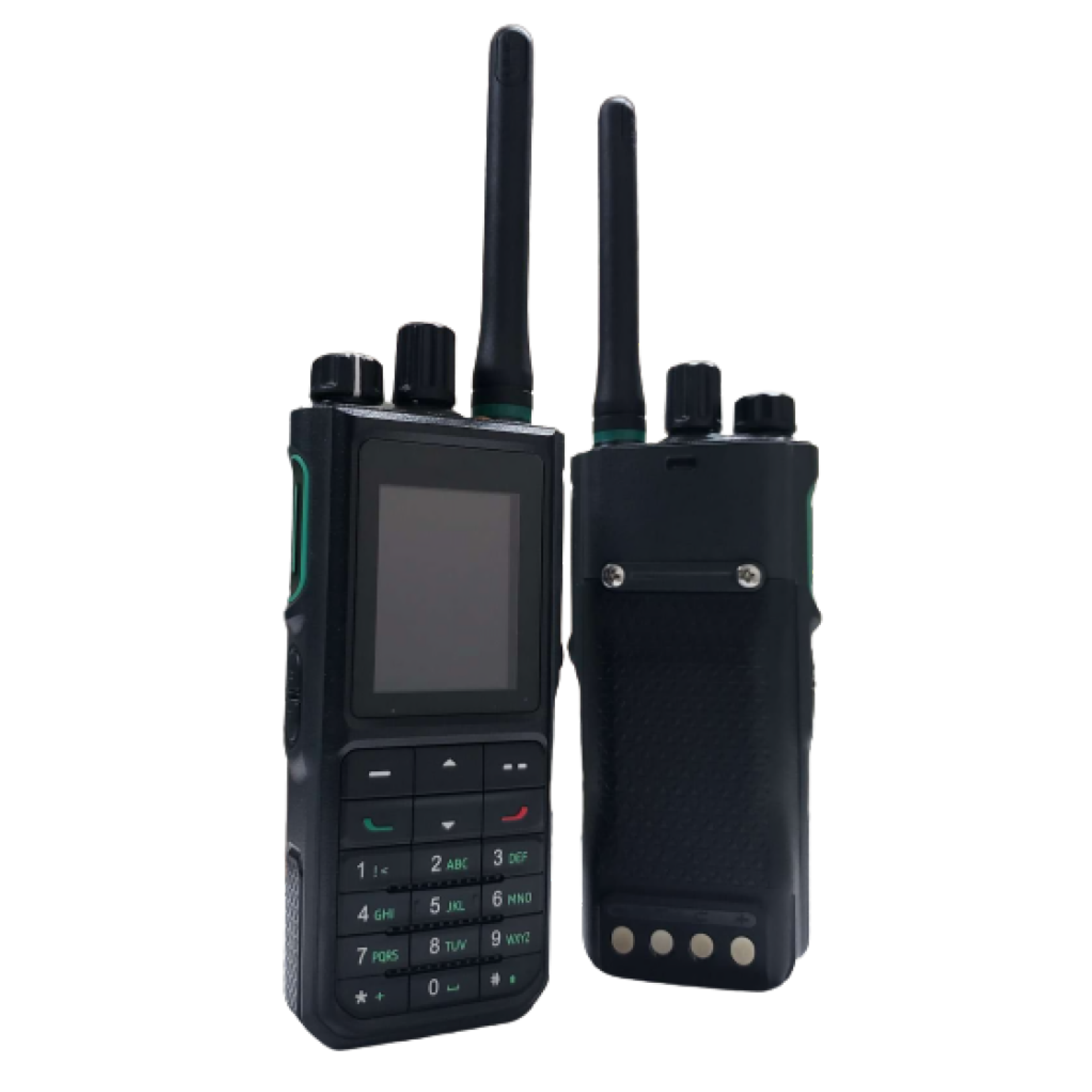
with P25 LMR, Wifi, LTE, Bluetooth & GPS
By providing access to these types of applications, the LTE overlay further improves communication and collaboration between different public safety agencies and first responders, increasing their response time and efficiency in the field, and improving public safety and security. And, because LTE/5G uses standardized protocols and interfaces, users beyond the range of their home public safety network now have the ability to maintain a connection using a local public safety 700 MHz network or a commercial wireless network.
P25 with Nybsys Sentra Core for integrated PTT
Nybsys bridges together a P25 network with cellular and wifi networks via LMR and ISSI Gateways. Nybsys Sentra core-based solution can be used to bridge other types of LMR traffic, such as DMR and Tetra, as well with P25.
Nybsys LMR gateways can connect P25, DMR, TETRA, VHF/UHF radios to interoperate with neighboring or remote systems. This allows for agency interoperability without trading radios or losing radio coverage. P25 portable repeaters can pave the way to extend P25 coverage and communicate with the Sentra Dispatch and the command infrastructure. This unified communication structure defines a faster and more secure communication method for multiple radio equipment manufacturers without having to buy a single vendor solution.
Nybsys LMR gateways can connect P25, DMR, TETRA, VHF/UHF radios to interoperate with neighboring or remote systems. This allows for agency interoperability without trading radios or losing radio coverage. P25 portable repeaters can pave the way to extend P25 coverage and communicate with the Sentra Dispatch and the command infrastructure. This unified communication structure defines a faster and more secure communication method for multiple radio equipment manufacturers without having to buy a single vendor solution.
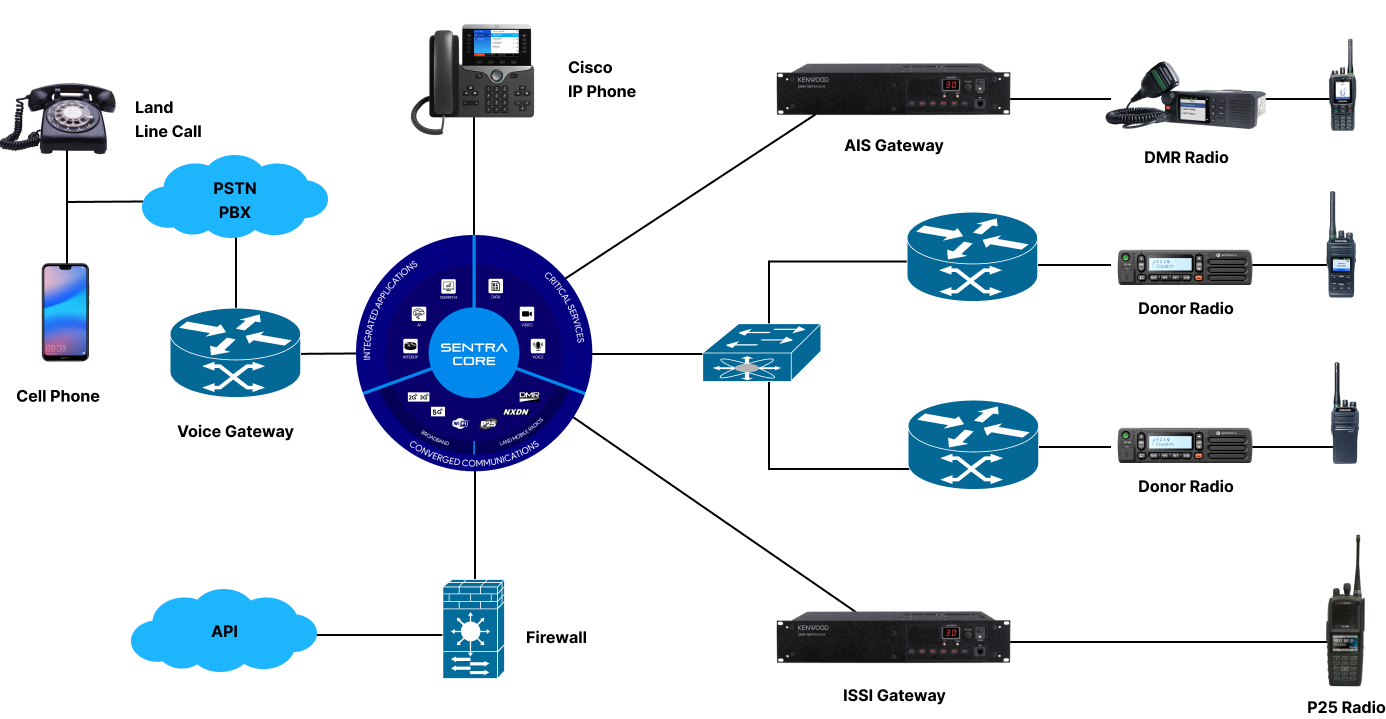
Integrated P25 Network architecture with Nybsys LTE
For public safety agencies or other P25 radio users, Nybsys offers a way to leverage the same functionality that consumer 4G/5G customers enjoy, including greater economies of scale (e.g., a lower cost/bit). An LTE/5G-based network can be overlaid on the P25 Land Mobile Radio (LMR) network to deliver both low-latency PTT and bandwidth-optimized advanced multimedia capabilities.
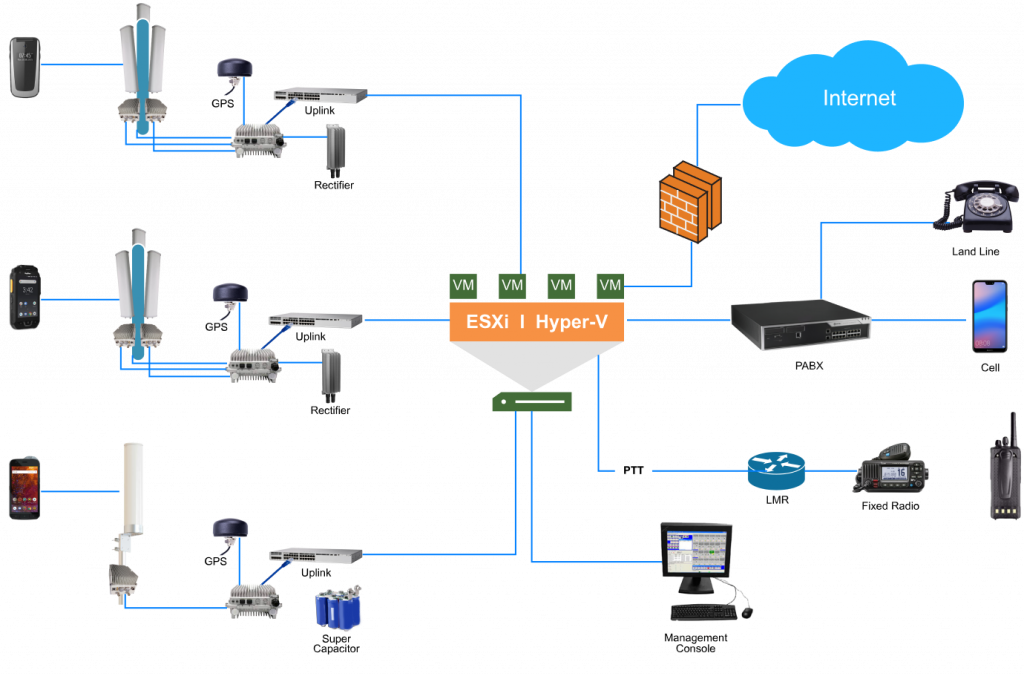
Nybsys Integrated P25 Solution Highlights
- Mission-critical, high availability solution
- Listen to multiple talk groups simultaneously
- PTT group calls within the LTE network
- Talk directly to the dispatch center
- Priority and emergency calls
- End-to-end encryption between LTE & P25
- Location services allow LTE & P25 units to be tracked
- For native P25 vocoder L3Harris BeOn integration
A P25 radio system is a proven technology solution that ensures encrypted data transmission and has better interoperability. NybSys is the only vendor providing a complete communication ecosystem that includes P25, tactical LTE, PTT App, and a unified web-based Dispatch system. Get in touch with us and get a free demonstration of our solutions.
Nybsys provides cutting-edge telecommunications solutions covering LTE and 5G technologies.
CONTACT US
- T: (408) 256-0836
- E: sales@nybsys.com
Copyright © 2024 NYBSYS. All Rights Reserved.